Use Casper
Build
Start Building
Ecosystem

Use Casper
Build
Start Building
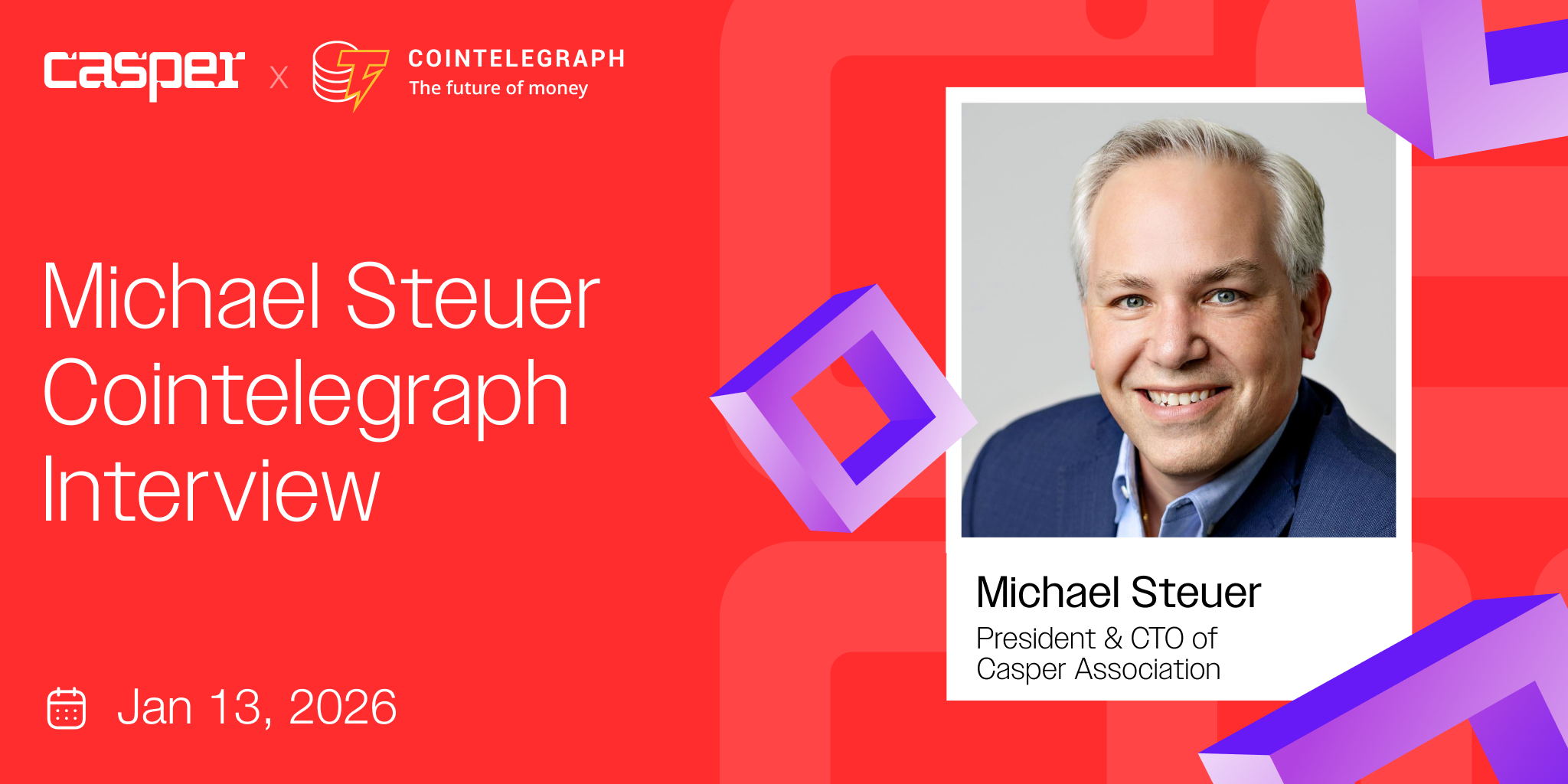
Michael Steuer, President and CTO of Casper Network, recently spoke with Cointelegraph in an interview focused on one of blockchain’s most persistent challenges: how interoperability, user experience, and decentralization intersect, and why progress has been slower than expected.
You can read the Cointelegraph article based on this interview here: Crypto’s decentralization promise breaks at interoperability
Below is highlights from the interview in a direct Q&A format, offering a more unfiltered view of Michael’s thinking and Casper’s approach to interoperability and user-first blockchain design.
Michael Steuer: I think the challenges go beyond just the technical.
There are real difficulties in getting fundamentally different systems to communicate and exchange value securely. Bridging assets between networks with probabilistic consensus, deterministic consensus like Casper, and optimistic rollups is hard because each operates under a very different security model, and the temptation to take shortcuts is always there.
But the challenges are just as big on the business, governance, and decentralization fronts. Today, interoperability is largely controlled by a small group of players such as Chainlink, LayerZero, and Axelar. They decide which chains and protocols are supported and who gets access, driven mainly by business incentives tied to fees or token economics.
Having a few parties control the “business of interoperability” runs directly against decentralization and the long-term interests of both the industry and users. At the same time, this creates a real opportunity, one we are actively exploring at Casper.
Michael Steuer: Imagine being at a store where the cashier asks whether you want to use the Mastercard network, the Visa network, or the SWIFT network. You would probably say, “No thanks, I’ll just pay cash.”
Yet in crypto, we still expect users to care about these kinds of choices, and that is a major blocker for mass adoption. Early adopters may tolerate this complexity, but if the industry wants to grow, it has to look beyond crypto-native users and make the experience accessible to everyone.
That means, in a sense, “taking the crypto out of crypto.” Good user experience is about helping users achieve their goals easily, and this is something our industry still struggles with.
At Casper, we focus on making blockchain accessible for both end users and developers by abstracting away as much complexity as possible. That means meeting people where they are and speaking a language they already understand. For example, our block explorer, CSPR.live, presents on-chain activity as a human-readable, social feed rather than dense tables full of hexadecimal data, helping even first-time users feel at home in Web3.
Michael Steuer: It goes back to the store payment example. Imagine a cashier saying, “We only use SWIFT here,” and customers replying, “I’m in the Mastercard ecosystem, my wallet doesn’t support SWIFT, and my money doesn’t work in your store.” It would sound absurd.
In crypto, this happens constantly. We have BTC maxis, the XRP Army, and countless other tribal groups. Every protocol has loyalists, and many ecosystems actively encourage this behavior. While it may seem beneficial in the short term, it ultimately creates an environment that is inaccessible to regular users, people who do not care which protocol powers their everyday interactions.
For the much larger group of non-crypto-native users, transparent interoperability is the only real solution. We should compete on use cases and product quality, not by building walled gardens that force users to choose sides.
Michael Steuer: This is really a case of short-term incentives versus long-term incentives. In the short term, most ecosystems focus on growing their own slice of the pie, without paying much attention to the size of the pie itself. But the reality is that we are still very early. On the retail side, we are mostly dealing with early adopters, and on the institutional side, we are only scratching the surface.
If we want to unlock the real adoption potential in both markets, interoperability is not optional, it is essential. I strongly believe it cannot remain under the centralized control of a small number of parties. Instead, protocols will need to tackle interoperability natively and ultimately converge around shared standards, much like other industries have done.
What’s been disappointing to me, as someone who has been in crypto since 2012, is seeing the AI industry, despite being much younger, leapfrog crypto on interoperability. Competing players there were able to come together around common standards because they understood that universal interoperability was necessary to make the technology useful at scale. As a crypto industry, we still need to reach that same realization.
Michael Steuer: It starts with an open standard that defines the specifications and interfaces for protocol-level interoperability, one that is not controlled by centralized parties, but instead allows protocols to securely exchange information and value with one another.
There is also a clear role for Layer One protocols to act as settlement layers for that interoperability. This does not need to be a winner-take-all model. As long as protocols adhere to shared, industry-wide standards, settlement can happen across multiple chains.
Protocols like Casper have a strong advantage as potential settlement layers for decentralized interoperability and bridging because of instant, deterministic finality. Optimistic and probabilistic consensus models are simply not reliable or convenient enough for these use cases. Nobody wants to wait for 64 confirmations, or deal with seven-day challenge windows in optimistic rollups.
Michael Steuer: Very simple. When the owner of a crypto asset can use that asset anywhere, without spending a second thinking about how to get it there. We still have a long way to go.