Use Casper
Build
Start Building
Ecosystem

Use Casper
Build
Start Building
Every major AI breakthrough over the past two years has expanded what software can do on its own.
Today, there are more agents than humans on the internet. They search the web, compare competing services, analyze massive documents, call APIs, write code, and coordinate multi-step workflows. They are remarkably capable at navigating the internet as it exists today.
Yet, they constantly hit a wall at the exact moment action matters most: the checkout page.
An agent can discover the exact dataset it needs to finish a task, find the best API price, or locate a hidden research article; only to freeze in front of a credit card form, a CAPTCHA, or a 2FA prompt waiting for a human to pull out a wallet.
To build a real machine economy, we don't need better checkout pages for AI. We need a payment architecture that software understands as naturally as it understands HTTP.
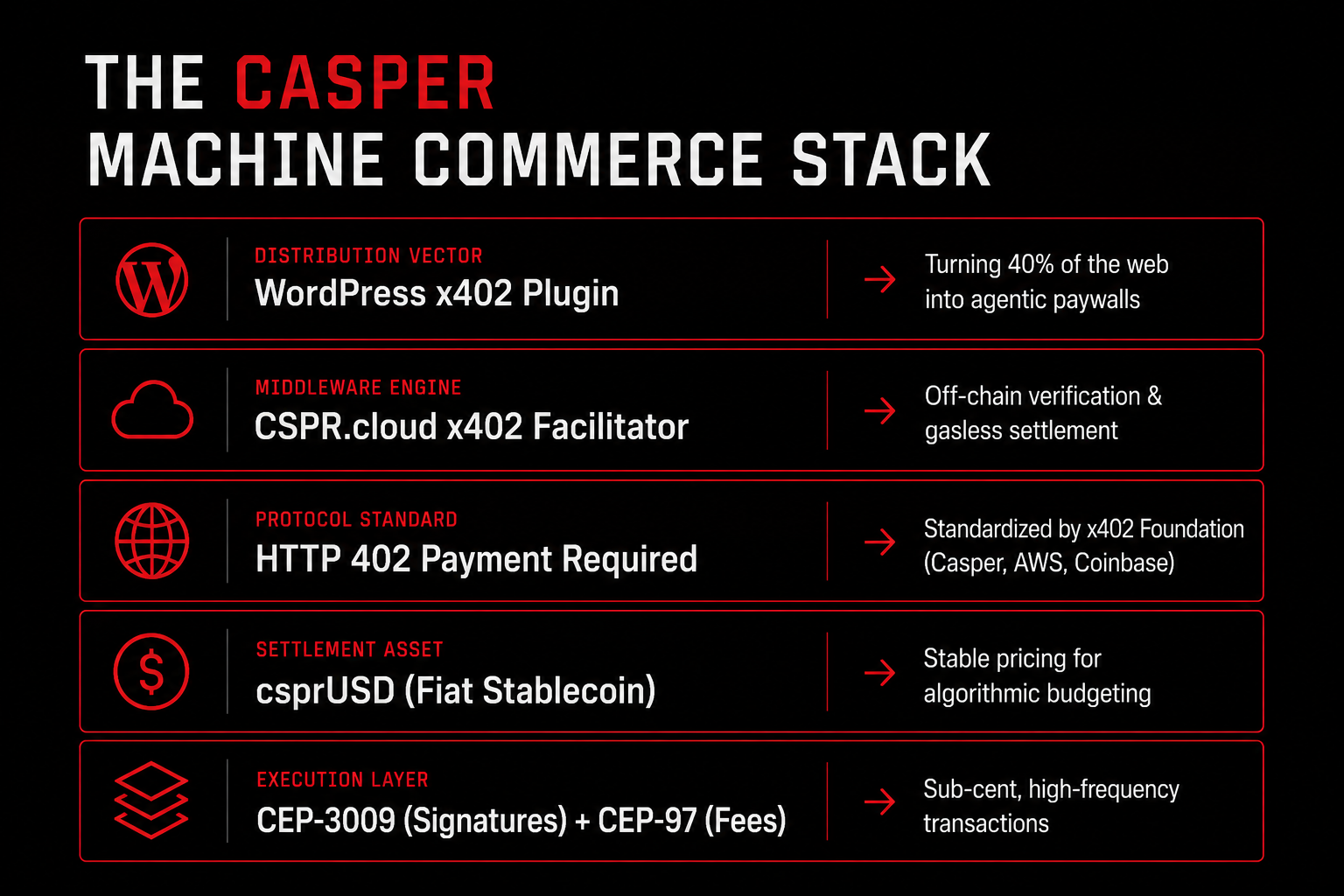
Casper solves this bottleneck not with a single band-aid tool, but by providing a complete, end-to-end stack designed specifically for machine-to-machine value exchange. Here is how the primitives fit together:

When your browser talks to a web server, it uses HTTP status codes. 200 OK means here is your page; 404 Not Found means it doesn't exist. Deep inside the original HTTP specification sits a long-dormant code: 402 Payment Required.
Casper is collaborating alongside industry heavyweights like AWS, Coinbase, Circle, and the Linux Foundation as founding members of the x402 Foundation. Together, we are working to standardizing HTTP 402 into a universal internet protocol for machine commerce.
Under x402, when an AI agent requests a protected resource, the server doesn't redirect to a payment page, but simply returns structured, machine-readable terms, such as:
"This resource costs $0.005 csprUSD. Submit signed authorization to this endpoint."
Payment becomes part of the web request itself, not a separate website loop.
An AI agent operating autonomously cannot manage crypto volatility while making execution decisions. If a token price or gas fee fluctuates 20% mid-operation, the agent’s algorithmic budget breaks.
To eliminate that uncertainty, transactions need to be denominated in a stable unit of account rather than a volatile asset. That’s the role csprUSD plays within the Casper ecosystem.
As Casper’s dollar-denominated stablecoin, csprUSD provides predictable pricing. When an API or publisher charges $0.001 for a request, the agent can reason about that expense with zero market risk.
This becomes especially important for micropayments, where agents may be making hundreds or thousands of tiny transactions across APIs, datasets, compute resources, or other digital services. Stable denomination allows those costs to remain measurable and programmable at scale, so agents can make spending decisions against fixed budgets without having to continuously account for token-price fluctuations.
Unlike human buyers who make a few large transactions a day, AI agents will make thousands of micro-purchases an hour: buying single paragraphs of text, individual API calls, or milliseconds of cloud compute.
If a $0.001 transaction costs $0.10 in network gas, or requires manual wallet clicks, the system fails. Casper addresses this through a coordinated execution architecture:
To understand how this infrastructure touches the real web, look at the x402 WordPress plugin, currently live on Casper Testnet.
WordPress powers over 40% of all websites on the internet. Today, web publishers face a lose-lose choice: let AI bots scrape their proprietary research and media for free, or install heavy paywalls that block both humans and automated systems.
The x402 plugin bridges Web2 with the agentic web by creating an automated machine gateway:
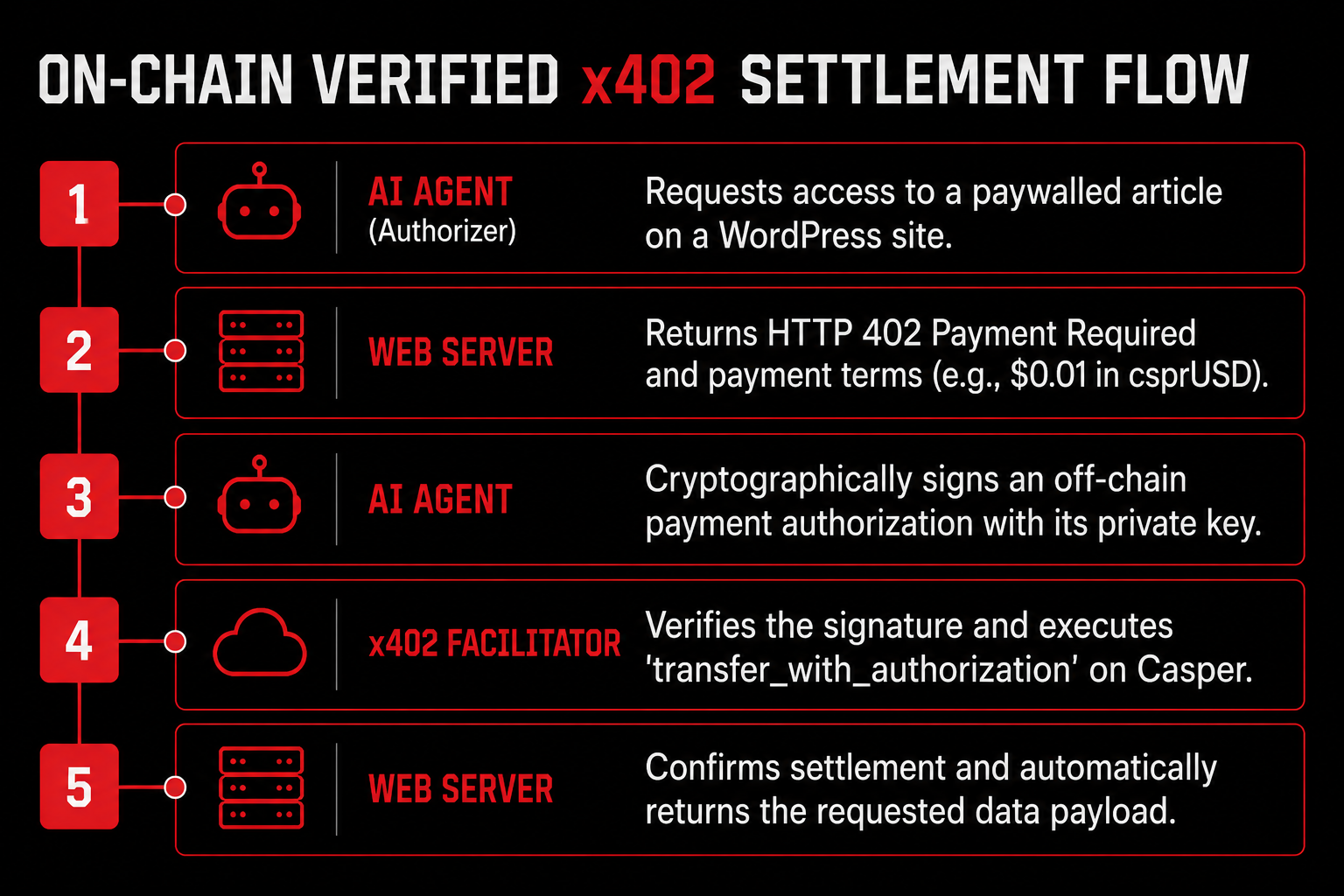
With a single plugin, 40% of the web can instantly turn its articles, APIs, and documentation into programmatic endpoints that charge AI agents per request.
The entire cycle happens programmatically in milliseconds. No human needs to click a button. No credit card needs to be charged.
An AI agent evaluated a price, paid a fraction of a cent in csprUSD through the Facilitator, and consumed the data. That’s it.
For thirty years, the internet was built as a reading room. We constructed hyper-optimized pathways for human eyes to consume data and manual checkouts for human hands to sign receipts.
As software evolves from passive retrieval engines into autonomous decision-makers, keeping them tied to human payment rails is like forcing an electric vehicle to stop at a steam engine's coal depot.
The x402 architecture does something far more profound than bypassing a subscription paywall. It gives software its own balance sheet.
When an AI agent can rent its own GPU compute on AWS, purchase real-time data feeds, pay specialized LLMs to execute sub-tasks, and monetize its own output without human friction, it ceases to be a tool. It becomes an active participant in global digital commerce.
The web connected human knowledge. The agentic web will orchestrate machine capital, and Casper is laying the native rails that make autonomous software truly sovereign.