Use Casper
Build
Start Building
Ecosystem

Use Casper
Build
Start Building
AI agents are brilliant digital assistants. They can code, they can scour databases, analyze markets, and summarize complex research in seconds. Yet, the moment they try to act as genuine participants in the digital economy, they hit a hard wall, and that problem is fundamental: the internet wasn't built for them. It was built for humans.
Think about how we purchase services online. You sign up, enter billing details, pick a monthly SaaS tier, manage invoices, approve line items, and so on. This workflow makes sense for a human sitting behind a monitor. But for an autonomous agent, it’s a broken loop.
An AI doesn't need a recurring monthly subscription just to make a single API call. It doesn't want to negotiate with a sales rep to unlock a single data point. It doesn’t need a fancy billing dashboard. Its requirement is radically simpler: request a service, see the price, pay instantly, get the result, and move on.
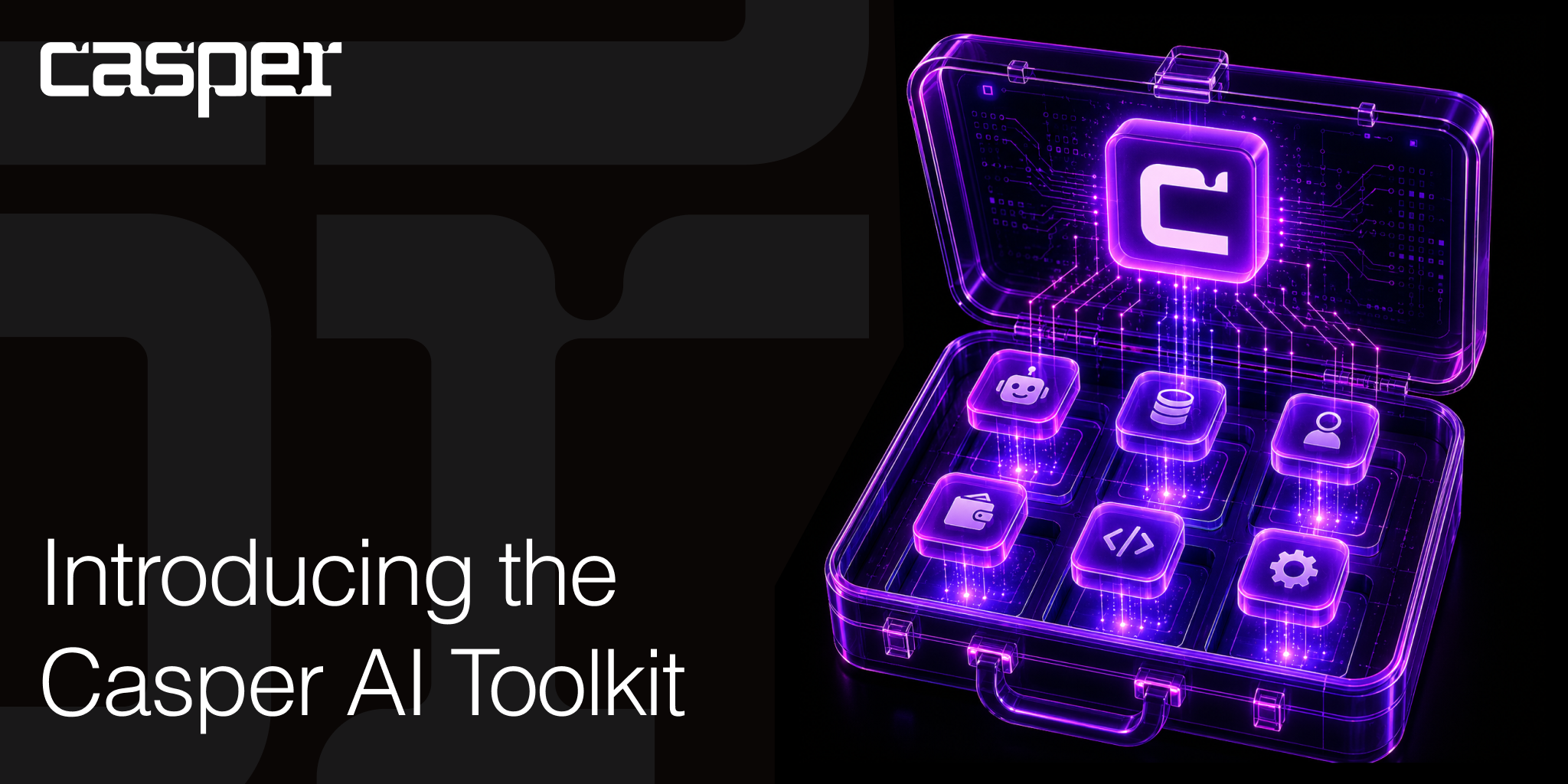
The Casper AI Toolkit solves this friction by introducing a new stack that grants AI agents two primary capabilities on the Casper Network.
First, agents can now transact independently. They can pay for services, call paid endpoints, and interact directly with DeFi protocols.
Second, they can build, leveraging Casper’s developer stack. They can write, test, and deploy new smart contracts with minimal human oversight.
The launch of the Casper AI toolkit also marks a major milestone. It is the first shipped initiative from the Casper Manifest, the network’s multi-year technical roadmap published just last month in May 2026.
The most immediate bottleneck for AI utility is money. Imagine an agent tasked with compiling a live market report. To get the job done, it needs to call a price feed, run a risk model, access a paid analytics endpoint, and trigger a minor on-chain action. Each step might cost a fraction of a cent. Forcing an agent to hold subscriptions for all these services is unfeasible. It needs a pay-per-request infrastructure.
With x402, payment becomes an integrated part of the data request itself. The flow is simple:
There are no API keys to manage or corporate credit cards to link. Most importantly, no human approval step is choking the pipeline mid-request.
The Casper x402 Facilitator is live on Mainnet today, making Casper the first WebAssembly-native Layer 1 blockchain with a functioning, HTTP-based micropayment layer built explicitly for machine-to-machine transactions.
To push this standard further, the Casper Association has joined the X402 Foundation to help co-develop the future of machine commerce.
MCP is an open standard that allows AI models to discover external tools and call them in a highly structured format. On Casper, agents can connect directly to core blockchain functions. They no longer need a human to open a wallet, check an explorer, or copy-paste hashes across different tabs.
Instead of pinging a user to check if a client's payment arrived, the agent monitors the ledger and detects the transfer itself. Instead of waiting for a developer to manually inspect a buggy contract, the agent reads the state changes and flags what went wrong. It turns agents into active users of the blockchain
The CSPR.trade MCP Server takes these capabilities straight into decentralized finance.
Through this MCP, agents can interact with Casper’s DeFi ecosystem using natural language and structured tool calls. They can map out optimal swap routes, compare liquidity pools, execute token swaps, and track portfolio balances.
Note on Security: This does not mean giving an AI unmonitored control over your treasury.
The core design ensures agents operate strictly within defined boundaries, explicit permissions, and locked transaction flows. A user might task an agent with monitoring a position and explaining yield fluctuations over the past day. Depending on user preference, a more advanced setup can allow the agent to execute swaps entirely autonomously when specific market conditions are met. Because signing happens totally locally via MCP, the private key never goes over the wire to the LLM, which gives users the flexibility to safely grant full autonomy or require a final manual approval.
If AI agents are going to drive the machine economy, they cannot just be consumers. They must be creators.
Odra Framework provides AI coding agents with a highly predictable sandbox. An AI agent pointed at Odra can generate clean contract logic, run tests, and prepare deployments with drastically reduced human intervention. A developer can prompt an AI agent to spin up a tipping contract, a tokenized workflow, or a lightweight payment service, cutting the time from concept to mainnet deployment to minutes.
Tying this together is the CSPR.build Agent Skills.
These skills provide the crucial integration layer agents need to turn raw code into functional apps, handling wallet handshakes, transaction signing, and event routing. They are powered directly by CSPR.cloud’s robust API infrastructure, allowing agents to read and write data to Casper at scale.
In short:
Odra helps the agent build the contract logic. CSPR.build Agent Skills help them wire that contract into a usable application. A smart contract sitting alone on-chain is useless; it needs middleware, APIs, and signing flows. The AI Toolkit unifies these pieces into a single, cohesive stack.
The AI Toolkit isn't just a collection of siloed payment or development utilities. The real breakthrough is the self-sustaining loop it creates.
One agent builds a service on Casper. A second agent discovers that service, pays to use it via x402, and uses the output to trigger a third action on-chain, which might involve another payment to a different agent entirely.
Picture an agent that maintains a paid endpoint providing verified supply chain data. A second agent, running logistics for an e-commerce platform, pays a fraction of a cent per request to check a shipment's status. Based on that data, a third agent automatically triggers an on-chain insurance payout or customer refund.
To kickstart development on this new stack, the Casper Association has launched the Casper Agentic Buildathon featuring a $150,000 prize pool.
The hackathon went live on June 2, with an intensive developer workshop at Istanbul Blockchain Week, where teams successfully built and deployed their first x402-powered agents live on the Casper Network.
Teams entering the competition receive sponsored x402 Facilitator access, allowing them to test and iterate on micropayment-driven apps without worrying about transaction overhead.
The toolkit provides the raw components, and the Buildathon is where they come together.
If you're ready to build AI agents that do more than talk, start here:
Join the Casper Agentic Buildathon: https://dorahacks.io/hackathon/2202/detail