Use Casper
Build
Start Building
Ecosystem

Use Casper
Build
Start Building
When Ethereum co-founder Vitalik Buterin warned in 2022 that “the future will be multi-chain, but it will not be cross-chain,” he pointed to a fundamental limitation: bridges that try to hop across multiple independent "zones of sovereignty" carry unavoidable security bottlenecks. Because cross-chain bridges rely on external validation, multisigs, or relayers to sync states across isolated networks, they became the ultimate Achilles' heel of DeFi, and the industry's most lucrative honeypots. Over $2 billion vanished into bridge exploits in 2022 alone.
The industry vowed to learn, but the vulnerability persisted long after. When a compromised RPC infrastructure struck a LayerZero-powered bridge in April 2026, it triggered a staggering $292 million loss for KelpDAO, proving that the attack surface had only evolved.
That reality carries vastly higher stakes today. Bridges are no longer just shuttling speculative meme tokens or wrapped assets; they are moving institutional Real-World Assets (RWAs). With tokenized equities and commodities actively trading across environments like Robinhood Chain, and financial titans like Apex Group committing to bring $100 billion in tokenized assets to the T-REX Ledger by June 2027, a security failure on an RWA bridge is no longer measured merely by a dented TVL.
Moving compliant assets without stripping away their legal and regulatory DNA requires an entirely different approach. That is why MAKE Group built AstralBeam: a secure cross-chain infrastructure connecting Casper to Ethereum, Base, Polygon, Robinhood Chain, and the T-REX Network.
Appreciating why AstralBeam is engineered the way it is requires dissecting exactly how and why legacy architecture crumbled.

The largest cross-chain exploits did not all fail in the same place. Some failed because too few keys controlled too much value. Others failed at the boundary between an off-chain assertion and on-chain execution. Some accepted state that had never been properly verified, proving that the attack surface extends well beyond the smart contract itself. Cross-chain infrastructure has to establish something deceptively difficult:
Did the event being reported on Chain A actually happen, is it final, and is there enough independent evidence for Chain B to act on it?
Every component involved in answering that question becomes part of the security model.
The lesson running through all four incidents is: cross-chain security is only as strong as the weakest assumption the destination chain is willing to trust.
AstralBeam was designed with this mandate: assume every individual component will be targeted, and enforce security on-chain.
A relayer can fail. An RPC provider can fail. Infrastructure can be compromised. One participant can see a different version of source-chain state than another.
The architecture is designed so that none of those events, by itself, is enough to move an asset.
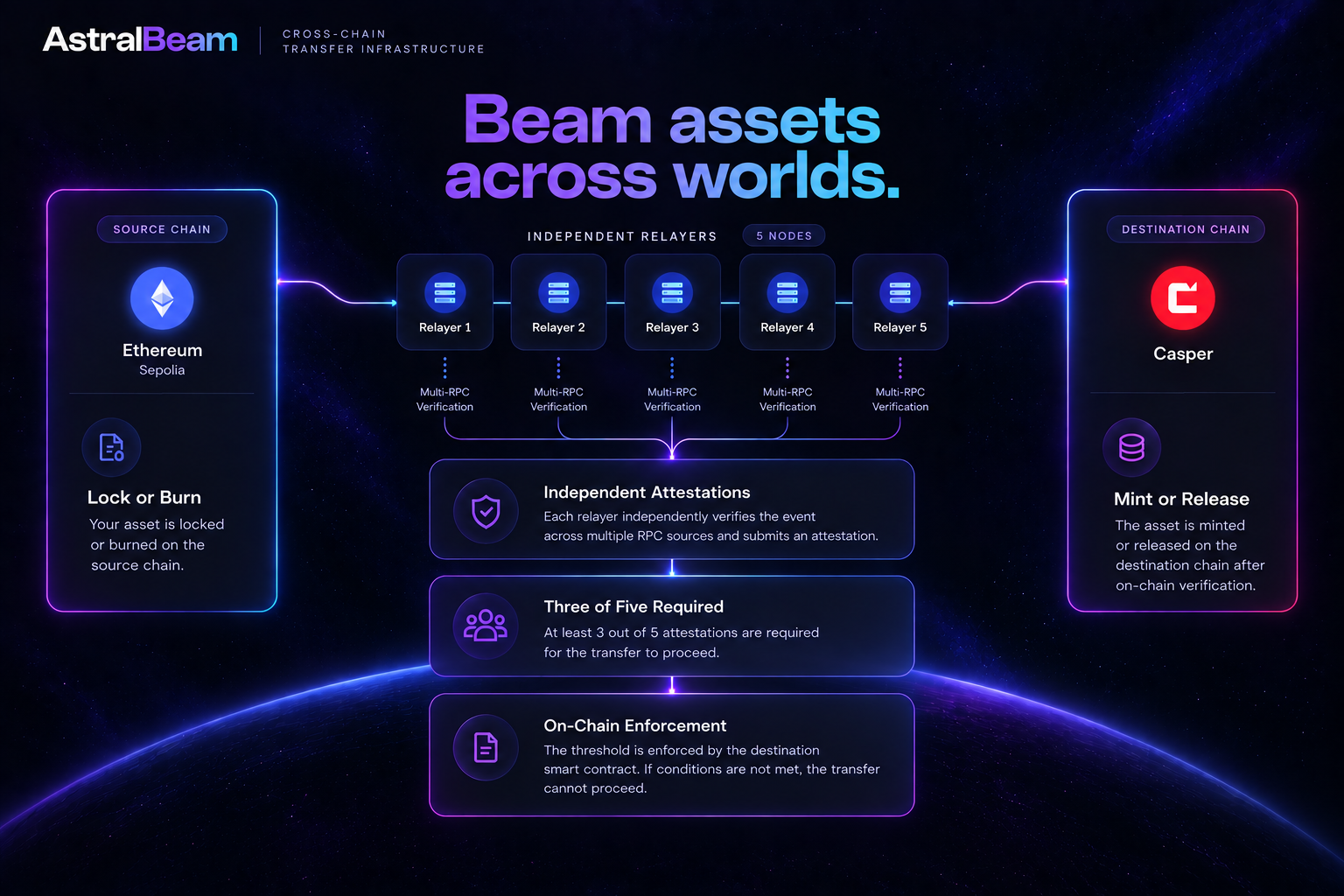
AstralBeam's verification relies on a mesh of five independent relayer nodes. Each relayer runs in an isolated, hardened infrastructure environment with zero public inbound network access and communicates exclusively via mutually authenticated TLS.
Crucially, no single relayer can move funds alone. For an asset transfer to proceed, at least 3 of the 5 relayers must independently verify the source-chain event across multiple RPC sources and submit cryptographic attestations. The required 3-of-5 threshold is enforced directly by the destination-side smart contract rather than by off-chain server orchestration.
AstralBeam is designed to be uncompromisingly Fail-Closed.
Before a relayer can attest to a source-chain event, the transaction must satisfy the finality conditions defined for that network, including its native finality requirements and an enforced confirmation-depth floor where applicable.
If the required finality cannot be established, RPC observations conflict, the required relayer quorum is absent, or the verification conditions cannot otherwise be satisfied, the transfer does not proceed. The system does not attempt to infer what probably happened or default to execution when source-chain state is ambiguous.
Before entering public testnet, AstralBeam spent more than six months under development, testing, and security review. Its core smart contracts, relayer infrastructure, and messaging specifications underwent multiple rounds of assessment by Halborn Security.
Traditional bridges are only concerned with the Value Plane, moving a token from Chain A to Chain B. But regulated securities carry compliance rules: investor eligibility, jurisdiction limits, and holding period restrictions.
AstralBeam introduces a dual-plane mechanism using the ERC-7786 cross-chain messaging standard:
While asset settlement takes place natively on Casper, the underlying transaction continuously references the shared compliance state on T-REX. This integration makes Casper the first non-EVM blockchain in the T-REX network.
For financial institutions, issuing or trading RWAs requires an L1 environment built specifically for real-world enterprise demands. Casper provides:
By linking Casper to Ethereum, Base, Polygon, and Robinhood Chain via AstralBeam, institutional issuers no longer have to choose between Casper's purpose-built execution environment and the deep liquidity of the wider EVM ecosystem.
The next phase of Web3 adoption will be powered by hardened cross-chain infrastructure where value and compliance travel together seamlessly and securely.
AstralBeam is officially live in its public Testnet phase. Explore the documentation, test the architecture, provide feedback, and start building: