Use Casper
Build
Start Building
Ecosystem

Use Casper
Build
Start Building
MAKE Group has introduced AstralBeam, a new cross-chain infrastructure connecting Casper with Ethereum, Base, Polygon, Robinhood Chain, and the T-REX Network. The launch connects Casper to the growing market for interoperable, regulated real-world assets.
Web3 has largely solved the issuance side of tokenization. Financial institutions can issue regulated assets under standards such as ERC-3643.
The next phase is allowing those assets to move beyond the blockchain where they originated without rebuilding the legal and compliance framework that governs them each time they enter a new network.

A conventional bridge moves value from one blockchain to another; however, regulated assets also carry rules governing ownership and transfer. Those rules cannot become disconnected from the asset simply because settlement happens elsewhere.
The T-REX Network was designed around that requirement. The T-REX Ledger maintains the compliance state for ERC-3643 assets while transactions continue to settle on whichever blockchain the asset is being used.
Through its ERC-7786 messaging layer, AstralBeam will connect Casper to the T-REX Ledger, allowing assets settling on Casper to reference the same compliance model used throughout the wider T-REX Network. With that integration, Casper expects to become the first non-EVM blockchain participating in the network.
AstralBeam moves assets between Casper and Ethereum, Base, Polygon, and Robinhood Chain through a process called beaming: An asset never exists on two blockchains at the same time. It disappears from one network and reappears on another after the transfer has been independently verified, like teleportation.
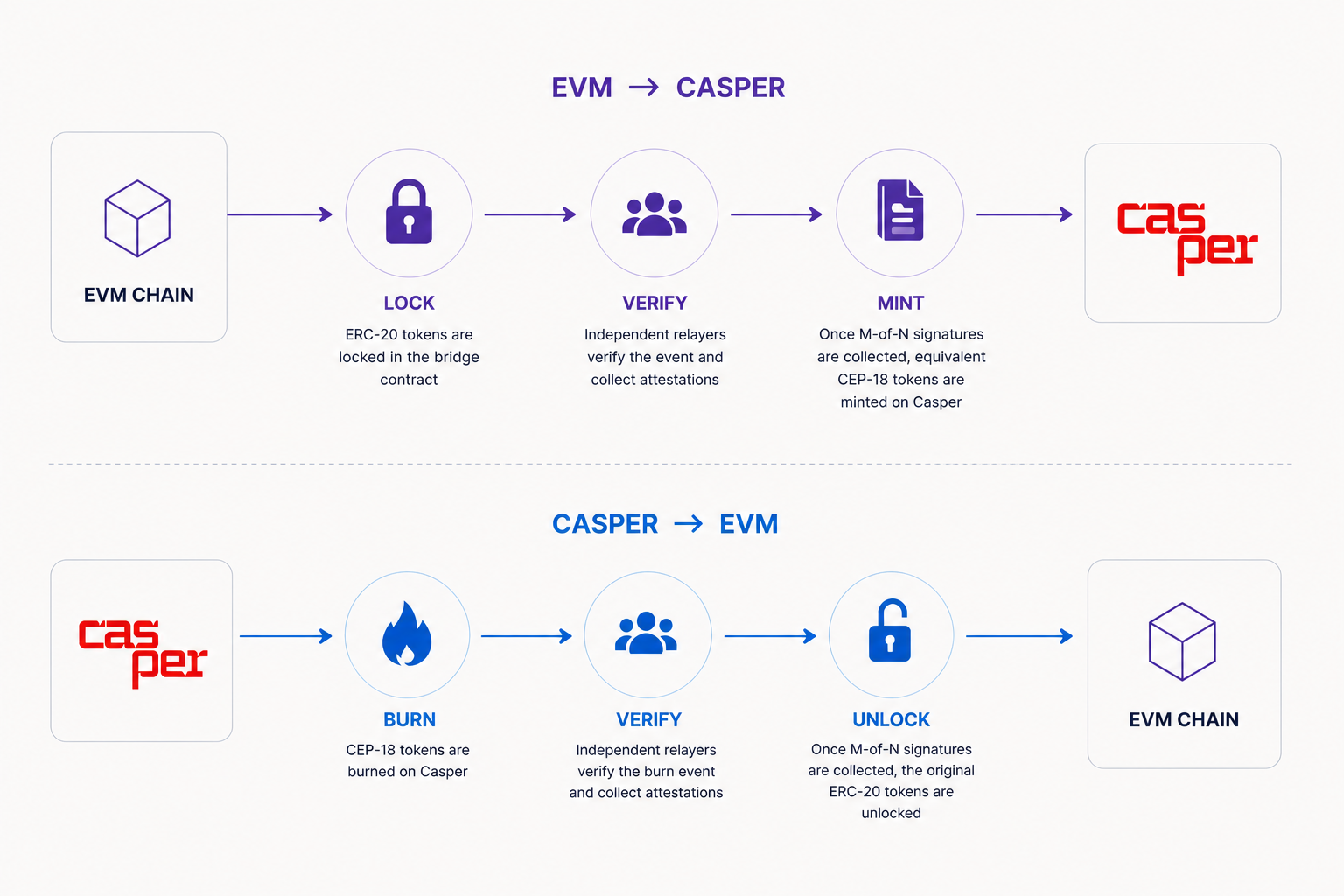
When assets move from an EVM chain to Casper, the original ERC-20 tokens are locked on the source network. After AstralBeam’s relayer network verifies the transaction, an equivalent CEP-18 token is minted on Casper. The return journey works in reverse. The CEP-18 token is burned on Casper, the transfer is verified again, and the original ERC-20 tokens are unlocked on the EVM chain.
AstralBeam also carries a second layer of information alongside the asset itself, which makes it well suited for the institutional adoption of regulated RWAs.
Through the ERC-7786 messaging standard, AstralBeam is designed to transport the compliance data required by regulated assets between Casper and the T-REX Ledger. Assets settle on the blockchain where they are being used, while the compliance information governing those assets continues to reference the same shared compliance layer.
Another aspect of AstralBeam that makes institutional tokenization more viable is its security.
Bridge exploits have historically concentrated trust in a relatively small number of operators, creating a single point of failure for assets moving between networks. When the underlying assets represent regulated financial products, that risk becomes more serious.
AstralBeam distributes verification across five distinct relayers. Each independently verifies source-chain events against multiple blockchain data providers before producing an attestation. A transfer proceeds only after at least three relayers reach the same conclusion, with the threshold enforced directly by on-chain contracts rather than operational infrastructure. If chain finality has not been reached, verification sources disagree, or any ambiguity exists, execution stops.
The platform has spent more than six months on Testnet and undergone multiple rounds of security review by Halborn before entering its public Testnet phase.
Casper is built to serve as infrastructure for regulated assets. Some of the network’s key differentiators in this area are upgradeable smart contracts, deterministic finality, predictable transaction costs, and native ERC-3643 support.
With AstralBeam, those capabilities now extend beyond Casper itself, connecting the network to the wider cross-chain market where regulated assets are being issued and used.
The next phase of tokenization will be defined by whether regulated RWAs can move freely between networks without losing the legal framework they were issued under. AstralBeam places Casper at the center of that architecture, giving institutions and developers a practical and secure foundation for building in a market where interoperability and compliance have to travel together.