Use Casper
Build
Start Building
Ecosystem

Use Casper
Build
Start Building
Choosing between Casper and the XRP Ledger comes down to a fundamental architectural difference: XRPL's hardcoded protocol features versus Casper's fully programmable smart contract logic.
XRPL relies on built-in ledger capabilities and predefined transaction types. Casper operates as a programmable Layer 1 where application logic can be updated and extended long after initial deployment.

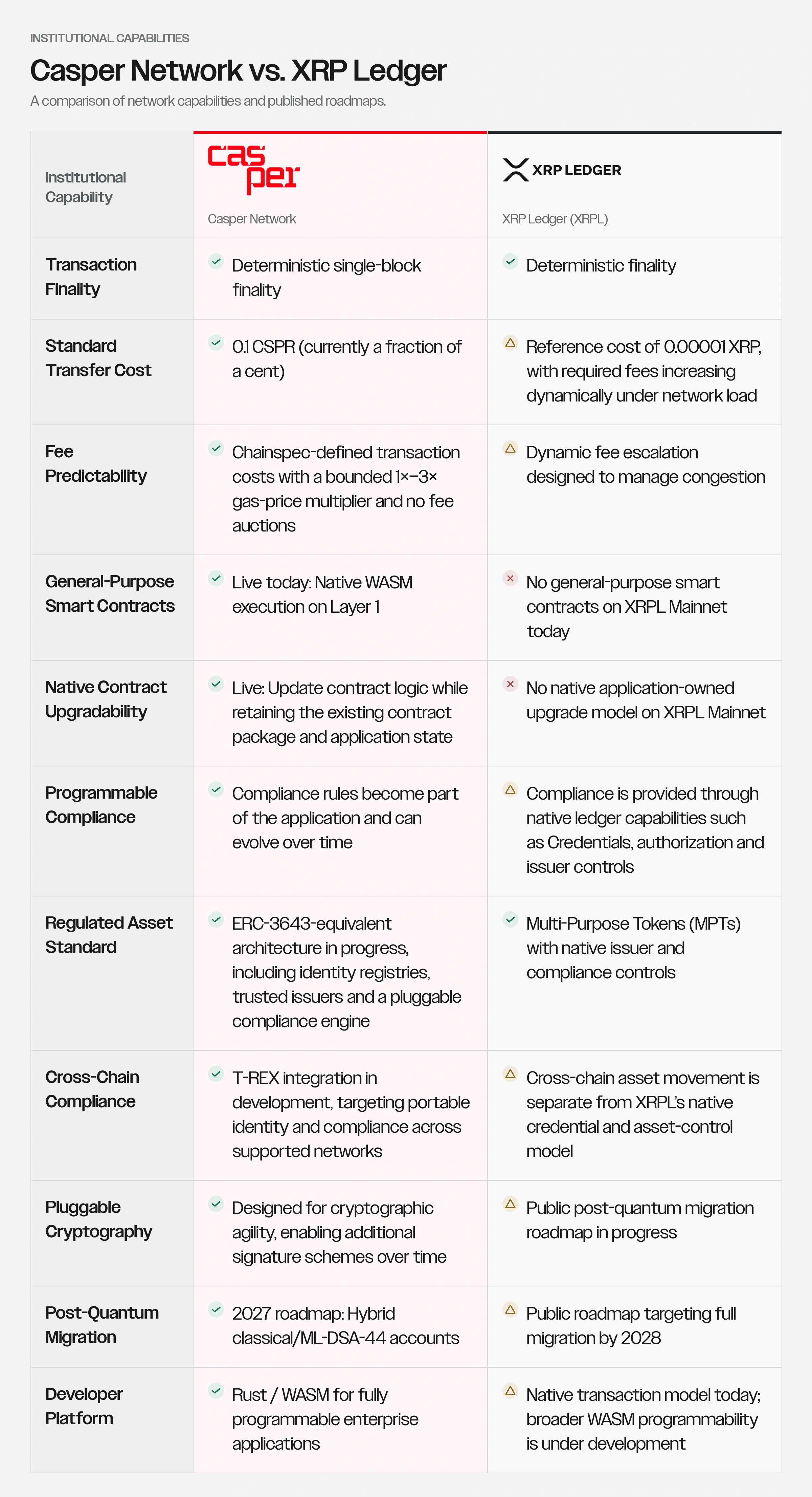
Casper smart contracts allow application logic to be updated on-chain while keeping the contract package, address, and state history intact. When regulatory rules or asset terms change, issuers adjust the smart contract logic directly without abandoning their deployed architecture.
Takeaway: Enterprise software requires ongoing maintenance. Blockchain infrastructure should not force a complete system rebuild when operational rules change.
XRPL adds functionality through hardcoded protocol features like Multi-Purpose Tokens, Credentials, and Permissioned Domains. Issuers needing custom behavior must wait for network-wide consensus amendments.
Casper runs general-purpose WASM smart contracts natively on Layer 1, allowing teams to code custom settlement rules, corporate actions, and compliance logic today.
Takeaway: Deploy tailored business logic on Layer 1 now instead of waiting for core protocol feature updates.
Fixed ledger compliance flags restrict long-term asset management. Casper uses an ERC-3643-equivalent framework connecting identity registries and trusted issuers to a pluggable compliance engine. Regulatory eligibility and jurisdictional rules can be modified over time without tearing down the underlying asset structure.
Takeaway: Pluggable compliance engines allow regulatory updates without re-issuing tokens or disrupting current holders.
Managing regulated digital assets spans their entire operational lifecycle. Casper integrates upgradeable smart contracts with ERC-3643 token standards, ProofLayer, and planned T-REX interoperability. Identity, compliance rules, and audit telemetry remain tied to the asset as it interacts with external networks.
Takeaway: Token minting is straightforward. Preserving regulatory enforcement as assets cross networks requires purpose-built architecture.
Assets operating on-chain for decades will outlive today's cryptographic standards. Casper was built with modular cryptographic agility, enabling new signature schemes to be integrated into the account layer over time. Casper's roadmap targets hybrid classical and ML-DSA-44 post-quantum accounts in 2027, whereas XRPL targets full migration by 2028.
Takeaway: Long-dated financial assets require future-proof security. Modular cryptography mitigates systemic encryption risk.
XRPL operates within fixed ledger primitives like Multi-Purpose Tokens and Credentials.
Casper provides execution flexibility: native L1 WASM smart contracts, state-preserving logic upgrades, programmable ERC-3643 compliance, T-REX cross-chain identity, and a 2027 post-quantum roadmap. Casper delivers the foundation required to manage regulated digital assets throughout their entire operational life.
→Explore Casper for Regulated Markets